Books
Showing 13–24 of 44 results
-
Acta Periodica Duellatorum
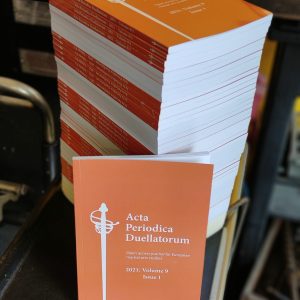
Acta Periodica Duellatorum – The Complete Collection
252,00 € Add to cartEvery APD book published to date, with a 10% discount.
Only untracked mail available. -
Classical
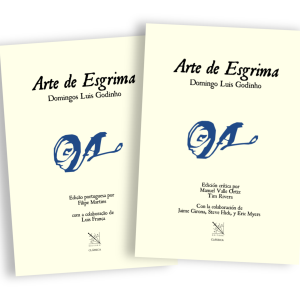
Arte de Esgrima (Pack x2 PT+ES)
38,00 € Add to cartThis is a pack for the joint purchase of the two versions, Portuguese and Spanish, of Arte de Esgrima by Domingo Luis Godinho. Through this product you can buy both copies with a 50% discount on the second.
In 1599, during the period when the Portuguese crown was united to the crowns of Castile and Aragon, a Portuguese master called Domingo Luis Godinho wrote a manuscript in Spanish entitled Arte de Esgrima (The Art of Fencing). The book was never published, and almost nothing is known about its author’s life beyond him being born in Santarém. However, the text is of utmost relevance in the study of Iberian schools of fencing, since it is the single complete treatise discovered so far describing the old style, the one to be displaced by the apogee of Verdadeira Destreza.
The work, originally written in 137 folios that we present as in 230 pages in this current edition, includes instructions for the single sword, sword and rotella, sword and buckler, twin swords, sword and dagger, sword and cape, plus the longest known text on the use of the iberian montante.
-
Classical
Arte de Esgrima (Portugese)
25,00 € Add to cartThis is the modern Portuguese edition of Domingos Luís Godinho’s Arte de Esgrima, a long-time out of stock classic from the AGEA editora fund that urgently needed to be revised and re-edited.
The Portuguese-language update was carried out by Filipe Martins, from the Academia de Esgrima Histórica, with help from Luís França. Between both, they prepared a modern and accessible version for easy reading, which is preceded by contextualizing antetexts and essays such as the legislation relating to swords in contemporary Portugal, or the role of fencing as an art in the cultural framework of the time.
In 1599, during the period when the Portuguese crown was united to the crowns of Castile and Aragon, a Portuguese master called Domingo Luis Godinho wrote a manuscript in Spanish entitled Arte de Esgrima (The Art of Fencing). The book was never published, and almost nothing is known about its author’s life beyond him being born in Santarém. However, the text is of utmost relevance in the study of Iberian schools of fencing, since it is the single complete treatise discovered so far describing the old style, the one to be displaced by the apogee of Verdadeira Destreza.
The work, originally written in 137 folios that we present as in 230 pages in this current edition, includes instructions for the single sword, sword and rotella, sword and buckler, twin swords, sword and dagger, sword and cape, plus the longest known text on the use of the iberian montante.
-
Classical
Arte de Esgrima (Spanish) 2nd Edition
25,00 € Add to cart→ After running out of print the first edition, we present this second edition with the correction of errata, some mistakes and the improvement of layout of some pages and the order of chapters. Also you can buy the new Portuguese edition through this link. And the pack of both with savings here.
In 1599, during the period when the Portuguese crown was united to the crowns of Castile and Aragon, a Portuguese master called Domingo Luis Godinho wrote a manuscript in Spanish entitled Arte de Esgrima (The Art of Fencing). The book was never published, and almost nothing is known about its author’s life beyond him being born in Santarém. However, the text is of utmost relevance in the study of Iberian schools of fencing, since it is the single complete treatise discovered so far describing the old style, the one to be displaced by the apogee of Verdadeira Destreza.
The work, originally written in 137 folios that we present as in 291 pages in this current edition, includes instructions for the single sword, sword and rotella, sword and buckler, twin swords, sword and dagger, sword and cape, plus the longest known text on the use of the iberian montante.
-
Classical
Compendio de las definiciones y principios de la ciencia de las armas
18,00 € Read moreA rare, little known book on 1697 Destreza.
A useful assortment of definitions on terminology.A Murcian author who died in Catalonia fighting the Bourbons.The solution to the mystery of the Oviedo M-29 manuscript.All that and much more within the 130 pages of this book by Diego Rejón de Silva, knight from the Order of Calatrava. -
Classical
Crisol de la Verdadera Destreza y Filosofía Matemática de las Armas
25,00 € Read moreFrancisco Lorenz de Rada (1660 – 1713) is the last great author — and perhaps the greatest — of the Verdadera Destreza, correcting and elaborating on the works of Carranza, Pacheco and Ettenhard. He was a soldier, a Knight of the Order of Santiago, Governor of Veracruz and, eventually, named Marquis of Torres de Rada. He studied Verdadera Destreza from the age of fourteen and was a fencing master and a prolific and exhaustive author. His magnum opus, Nobleza de la Espada (1705), is a compendium in three books of more than 1,300 pages where he constructs, starting from mathematical and theological elements, a geometric and rationalist system for the use of the rapier.
This work, Crisol, is to a certain extent a precedent of Nobleza, and also a previous stage in the theoretical and practical evolution of its author, in transit from Pachequism to his own expression. There are many parts that are reproduced almost verbatim in Nobleza, but in Crisol a more conventional scheme is followed, similar to other works of Destreza, in which the atajo is described in a generic way (although distinctions are established between one side and the other) and then the Tretas Generales as operating procedures to practice Destreza, ending with a section dedicated to countering Italian fencing (which is notably increased in his great final work).
This edition is of great value, since the only two copies of Crisol that are preserved are incomplete. The text that we present here uses both sources to reconstruct the work as it must have existed.
We have also carefully replicated and (in some cases, following Rada’s own instructions) corrected the 25 diagrams that accompany the text, which we present in our edition as fold-out plates.
Overall, this title is a fundamental piece for any student of Verdadera Destreza, who will hardly find a more exhaustive or precise work in a modern edition.