Books
Showing 25–36 of 44 results
-
Classical
Destreza das Armas
22,00 € Add to cartAbout a hundred years ago, a man named Sousa Viterbo –poet, archaeologist, historian, journalist– undertook the major task of writing a portuguese bibliography of fencing books, which he published under the title «A Esgrima em Portugal: Subsídios para a sua História».
While the text gathered all the sources he knew at the moment of publishing, Viterbo kept researching and unearthing new fencing treatises during his life. Many of these findings he noted down in small scraps of paper which he kept between the pages of his own copy of the «Subsídios». We have managed to locate this specific exemplar, and from the notes Viterbo’s left within its pages traced back the whereabouts of the sources not listed within the printed copy.
It is one of these hiterto unpublished manuscripts which we now present: «Destreza das Armas», a compilation of portuguese Destreza translations and original texts.
-
Classical
El Bisoño Instruido
20,00 € Add to cartA military treatise from the beginning of the 17th century believed to have been lost. There is a single copy in the Coimbra Library.
We present a critical edition of this work where the author’s military life is recounted, along with advice and experiences to carry out military operations both on land and at sea. It is interesting a section on the handling of the pike and other weapons as well as the ways of fighting at sea and on land, organization of the army, military positions, etc.
In the introduction we include the parts that deal with the handling of the pike in other contemporary treatises, as well as a summary of the abundant military tradition of this time.
-
Classical
El discípulo instruido y diestro aprovechado en la ciencia filosófica y matemática de la Destreza de las armas (2 volumes)
45,00 € Add to cartA fundamental and, until now, unpublished work of which only one copy exists in a private collection not available to the general public.
Written by D. Diego Rodríguez del Canto, master of arms for the king in the 18th century, this work illustrates the late Verdadera Destreza, its evolution, and the beginning of its decline.
Exceptional among the literature of its genre, this treatise offers through its 434 pages 200 illustrations accompanying each explanation, showing geometric principles up to the decomposition of movement techniques, references for measurements, knowledge trees, etc.
The manual documents how the traditional Destreza adapts to new styles. Rodríguez del Canto created the innovative Doctrina Mixta, incorporating Italian and French techniques. The author cites Pacheco, Ettenhard, and Rada and structures his work into four treatises:
- The first treatise covers philosophical and mathematical principles, applying Arithmetic, Statics, Geometry, Music, and Astronomy; the measures of the weapons (montante, rapier, smallsword, and dagger) and the geometric postures of the three schools: the Iberian, the Italic, and the Gallic.
- The second treatise covers the Destreza categories, body and weapon measurements, lines and figures, the diversity of stances (plantas), steps (compases) and motions, the method of holding the sword, and the diagonal postures.
- The third treatise focuses on the six rules for tretas (Agregación, Atajo, Incluir, Transferir, Formar, and Librar), including the engavilanadas and encadenadas and the smallsword technique.
- The fourth details the use of sword and dagger or sword and cloak, opposition to the left-handed opponent (zurdo), speed drills, and fencing warnings.
Finally, the manual includes a catalog of sword blade manufacturers, with their marks, dated 1734.
-
Classical
Encyclopedia metódica. Artes académicos. Esgrima.
25,00 € Add to cart.
.
Acompanha-se do nosso habitual aparato editorial, e dum artigo contextualizante por Alberto Bomprezzi.
The legendary Encyclopèdie from the French Revolution, translated and adapted into Spanish at the end of the XVIII century.
The text includes the Girard plates from the original publication, reproduced in small size in the spots where they are mentioned, for ease of reference. At the end of the book an appendix holds fold-outs of the plates made for the spanish edition, in faithful reproduction of the original format (about 42×30 cm).
The text itself is preceded by our usual editorial apparatus, and a context-setting essay by Alberto Bomprezzi.
Large format, 21 x 30cm. 100 pages + 11 fold-out 30×40 cm plates.[:es]
.
.
-
Classical
Espada Firme
15,00 € Read moreThe Espada firme by Manoel Martins Firme is a transitional text from the 18th century in which the roupeira sword is fading but the smallsword fencing is still not completely replaced.
A work of obvious interest to study the 18th century or, simply, to have a complete overview of the evolution of fencing on the peninsula over the long history. -
Minor
Grandezas de la espada
30,00 € Add to cartOne of the most important works on the Destreza. Pacheco de Narváez’s first book, in which he presents his system in great detail. Destreza in its early stages.
Essential edition; does not include critical notes or commentaries, only the standardized text. Basic layout.Also available on Lulu.com
-
Agea presents
Há Uma Única Arte da Espada (GNM HS 3227a)
20,00 € Add to cartThis is a very liberal Galician-Portuguese translation of the manuscript 3227a from the Germanische Nationalmuseum Nuremberg. It is authored by Diniz Cabreira, director of «Arte do Combate», a galician HEMA school specializing in early Kunst des Fechtens. This edition was created as study material for the school students, but we hope it will be useful to the rest of the portuguese-speaking community. In this regard AGEA Editora is pleased to contribute our editorial resources to facilitate reaching the international public.
-
Uncategorized
La Espada de Dos Manos y El Montante (2nd ed.)
20,00 € Read moreWithin the «Manuais» editorial line, dedicated to studies, translations and interpretations, we bring this work by Pablo Moya, who has already delighted us with his academic work on Vulgar fencing. This time he breaks down the existing knowledge about two-handed swords and montantes in the Iberian panorama of the early Modern Age.
Given the extent to which he deals with the subject, the limits of an article for a periodical publication are exceeded, so we offered him the possibility to publish a monograph. Once the minimum production costs have been covered, it is our intention to publish openly in order to facilitate its dissemination.
Index (content in Spanish):
- Parte 1: La Espada de dos Manos
- Introducción
- El contexto europeo e ibérico de la espada de dos manos
- La esgrima en la baja edad media ibérica
- Los esgrimidores y la espada de dos manos
- Tratadistas y escritos sobre la esgrima con espada de dos manos
- La espada de dos manos y los gremios de espaderos
- La espada de dos manos en los juegos caballerescos y los desafíos
- La espada de dos manos en la guerra
- La evolución de la espada de dos manos al montante
- Conclusiones
- Parte 2: El Montante
- Introducción
- Los orígenes del montante
- Inicio del uso del montante en los territorios ibéricos
- El montante en la esgrima ibérica
- Tratados y escritos de la esgrima con montante
- El montante en la legislación y el ámbito civil
- Espaderos y montantes
- Santos, bailes y montantes de fuego
- El montante en el arte de la guerra
- El montante en el campo de batalla
- El montante en la guerra de asedio y los combates urbanos
- El montante en la guerra naval
- El ocaso del montante
- Conclusiones
- Referencias bibliográficas
Within the «Manuais» editorial line, dedicated to studies, translations and interpretations, we bring this work by Pablo Moya, who has already delighted us with his academic work on Vulgar fencing. This time he breaks down the existing knowledge about two-handed swords and montantes in the Iberian panorama of the early Modern Age.
Given the extent to which he deals with the subject, the limits of an article for a periodical publication are exceeded, so we offered him the possibility to publish a monograph. Once the minimum production costs have been covered, it is our intention to publish openly in order to facilitate its dissemination.
Index (content in Spanish):
- Parte 1: La Espada de dos Manos
- Introducción
- El contexto europeo e ibérico de la espada de dos manos
- La esgrima en la baja edad media ibérica
- Los esgrimidores y la espada de dos manos
- Tratadistas y escritos sobre la esgrima con espada de dos manos
- La espada de dos manos y los gremios de espaderos
- La espada de dos manos en los juegos caballerescos y los desafíos
- La espada de dos manos en la guerra
- La evolución de la espada de dos manos al montante
- Conclusiones
- Parte 2: El Montante
- Introducción
- Los orígenes del montante
- Inicio del uso del montante en los territorios ibéricos
- El montante en la esgrima ibérica
- Tratados y escritos de la esgrima con montante
- El montante en la legislación y el ámbito civil
- Espaderos y montantes
- Santos, bailes y montantes de fuego
- El montante en el arte de la guerra
- El montante en el campo de batalla
- El montante en la guerra de asedio y los combates urbanos
- El montante en la guerra naval
- El ocaso del montante
- Conclusiones
- Referencias bibliográficas
- Parte 1: La Espada de dos Manos
-
Classical
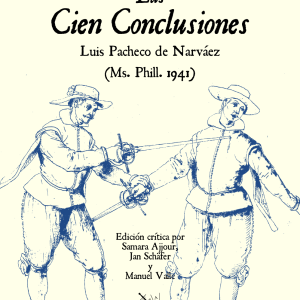
Las Cien Conclusiones (Ms. Phill. 1941)
20,00 € Add to cartThis is a critical edition of the “Berlin Manuscript,” Ms. Phill. 1941, to contain the Cien Conclusiones and the Dieciocho Contradicciones of Luis Pacheco de Narváez. It replaces in our catalog our exhausted first edition of the Cien Conclusiones.
-
Classical
Las cien conclusiones o formas de saber de la verdadera destreza y dieciocho contradicciones a las tretas de la destreza común
14,00 € Read more.
. Esta edição é substituída pela nova edição do Ms. Phill. 1491
. .
This book is sold out. This edition is superseded by our new edition of Ms. Phill. 1491
This edition includes all known variants of the Cien Conclusiones by Pacheco, (up to twelve sources, including several unpublished manuscripts) and fixes the final text. It includes the history of the original texts, a relationship tree between the different variants and correlation tables numbering the different editions. The illustrations reproduce those from the manuscript of Berlin.[:es]
.
.
-
Glossa
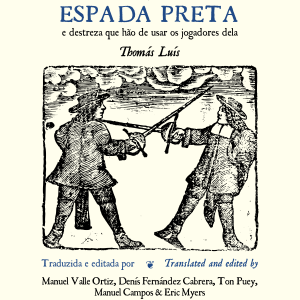
Lessons for the Practice Sword
20,00 € Add to cartThis is a second edition of our first published book, Tratado das lições da espada preta, by the late XVII century portuguese master Thomas Luiz. Where the first one was a critical edition, documenting the stemma codicum with its variant sources and setting down the canonical copy, this second edition aims to make this book accessible to a worldwide public by providing an english translation next to the portuguese source.